Trying ISM in the browser, from the SSIM to a layered graph
Learn the assumptions and mathematics of ISM, then follow the built-in seven-element sample from the SSIM to reachability, levels, and a directed graph.
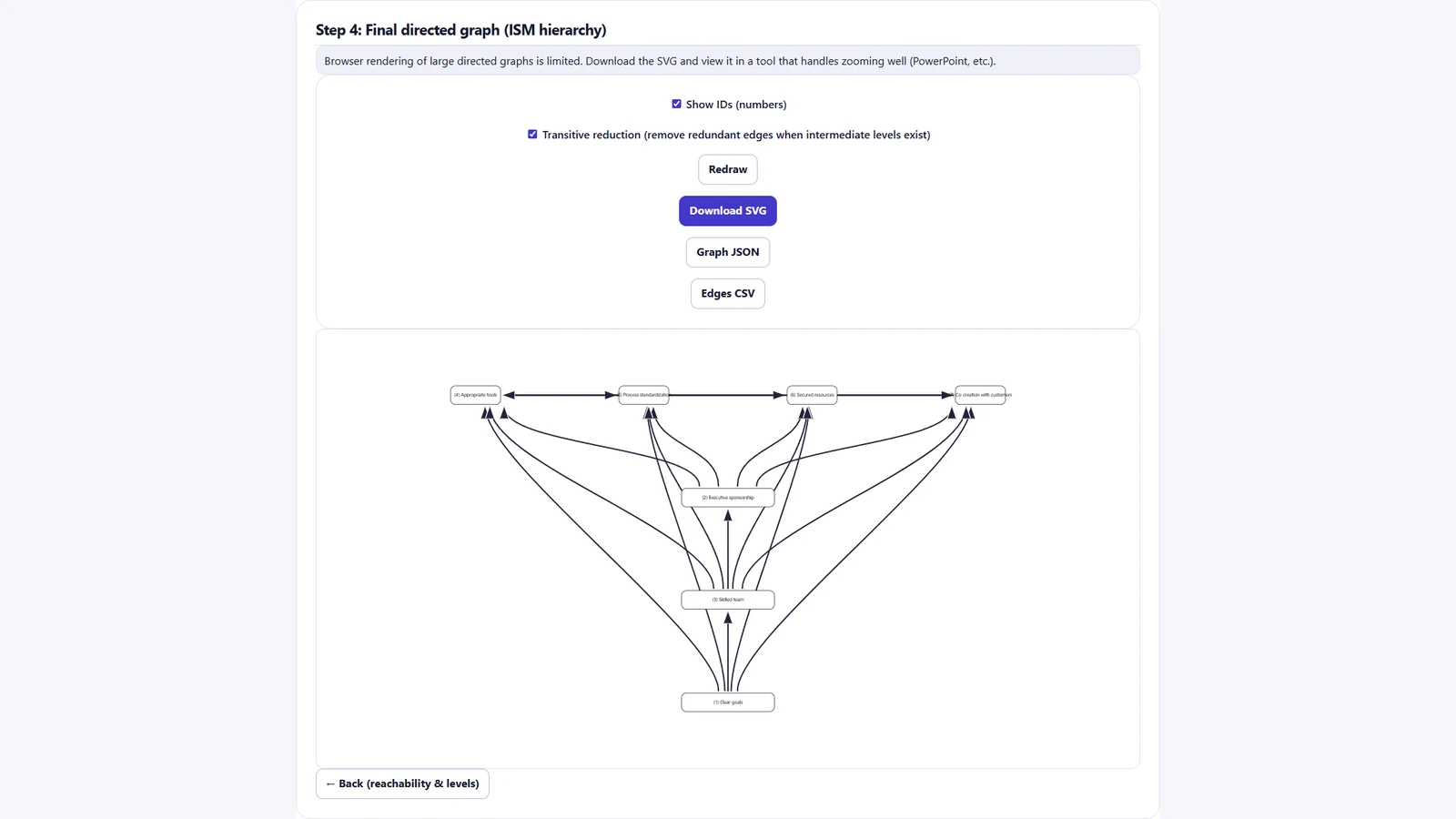
It’s easy to say that a way of working is good or bad. It’s harder to say what that judgment rests on. When a new practice isn’t taking hold, are the goals unclear? Is the team stretched? Is it missing executive support? A list of factors leaves open how each one relates to the others.
An earlier article on ISM on this site was referenced in a number of places. This is a rewrite of that article to go with the current browser tool.
What is ISM?
Interpretive structural modeling (ISM) breaks a complex problem into elements and represents their relationships as a layered directed graph. People who know the subject decide what the elements are and which direct relationships to enter. The model organizes the structure implied by those judgments.
DEMATEL (Decision Making Trial and Evaluation Laboratory) is another method for structuring complex systems. ISM looks at which elements can be reached by following a defined relation and how they fall into levels. DEMATEL assigns numerical strengths to direct influences and accounts for indirect influence when combining them. Hsieh et al. (2016)
Define the elements and the relation
Start with a finite set of elements S = {s₁, s₂, …, sₙ}. Define one binary relation R on ordered pairs of elements. If you choose “helps bring about,” write sᵢ R sⱼ when i helps bring about j and draw it as sᵢ → sⱼ. Switching between “helps bring about,” “happens before,” and “is more important than” from one arrow to another makes the graph hard to interpret.
Warfield assumes the modeled relation is transitive. If sᵢ R sⱼ and sⱼ R sₖ, then sᵢ R sₖ. The initial judgments record direct relationships. A path from i to j to k can therefore add an indirect relation from i to k even if there was no direct entry. Real influences need not be transitive. The resulting graph shows what follows from the assumptions and judgments that went into it. Warfield (1974)
Convert the SSIM to zeros and ones
The structural self-interaction matrix (SSIM) records the direct relationship for each pair. With i as the row and j as the column, one cell in the upper triangle records both directions. The converted matrix is the initial reachability matrix (IRM).
| SSIM | Judgment for the pair | IRM (i, j) / (j, i) |
|---|---|---|
| V | From i to j (i → j) | 1 / 0 |
| A | From j to i (j → i) | 0 / 1 |
| X | Both directions (i ↔ j) | 1 / 1 |
| O | Neither direction has a direct relation | 0 / 0 |
Set the IRM diagonal to 1. Every element can reach itself without following an arrow. This makes reachability reflexive.
Compute the closure using Boolean arithmetic
In a Boolean matrix product, use AND (∧) in place of multiplication and OR (∨) in place of addition. A path through a particular intermediate element exists if both legs exist. It takes only one intermediate element with both legs for the result to be 1.
| x | y | x ∧ y | x ∨ y |
|---|---|---|---|
| 0 | 0 | 0 | 0 |
| 0 | 1 | 0 | 1 |
| 1 | 0 | 0 | 1 |
| 1 | 1 | 1 | 1 |
Since 1 ∨ 1 = 1, two paths still give 1. Call the IRM M. Entry (i, j) of M² is the OR of M(i,k) ∧ M(k,j) over all intermediate elements k. The final reachability matrix T combines the Boolean matrix powers as follows.
T = M⁰ ∨ M¹ ∨ … ∨ Mⁿ⁻¹ (M⁰ = I, the identity matrix)
With n elements, you need at most n−1 arrows to reach any reachable element along a path with no repeated vertices. Since the diagonal is set to 1, the result is the reflexive transitive closure of the entered relation. The tool labels this matrix “Transitive closure.”
Use reachability and antecedent sets to find the levels
The ones in row i of the final matrix give the reachability set R(i), the elements i can reach. The ones in column i give the antecedent set A(i), the elements that can reach i.
- Among the remaining elements, find those satisfying
R(i) ∩ A(i) = R(i). Every remaining element reachable from i must also be able to reach i. - Assign those elements to the current level, starting with Level 1.
- Remove them from the rows and columns under consideration, and repeat.
Elements that can all reach one another in a cycle go into the same level. A level can also contain separate groups. For example, two unconnected elements with no outgoing arrows both qualify for Level 1.
Read the directed graph
Place the elements at their assigned levels and use arrows to show relationships. If there is a path i → j → k, you can omit an additional arrow i → k while retaining the same reachability. For an acyclic graph, removing redundant arrows while preserving which pairs are reachable is called transitive reduction. Keep the SSIM or initial matrix alongside the graph if you also want a record of the direct judgments.
Try the built-in sample
Step 1 — Load the sample
Open the ISM step-by-step assistant and click Load sample. It fills in the elements and SSIM and opens Step 2. The seven elements, in order, are Clear goals, Executive sponsorship, Skilled team, Appropriate tools, Process standardization, Secured resources, and Co-creation with customers. Here we’ll read an arrow as “helps bring about” its destination.
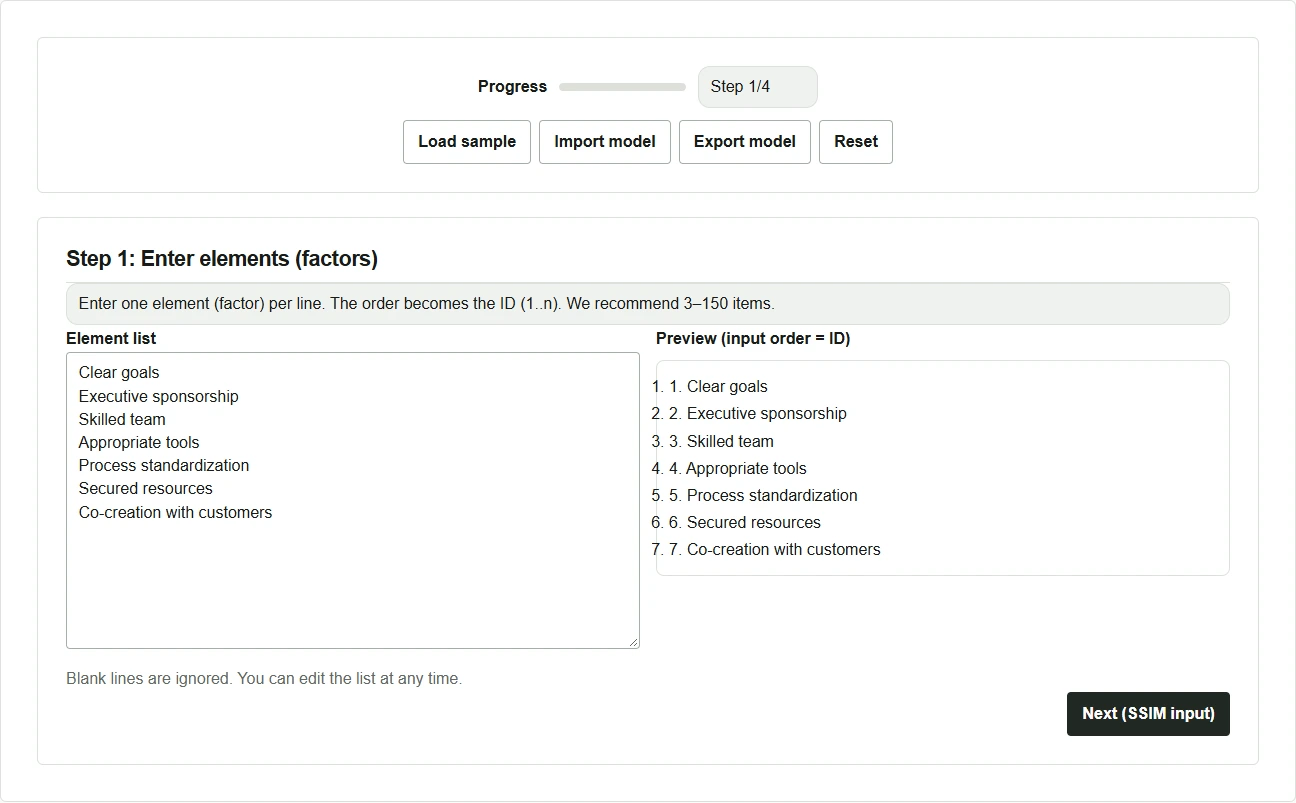
Step 2 — Check the directions in the SSIM
Open Edit the upper triangular matrix directly. Of the 21 pairs, only row 1, column 2 is blank. Enter O for that first pair. We’ll leave out a direct arrow from 1 to 2 and see whether there is a path through another element.
Now look at A in row 2, column 3. The arrow runs from column 3, Skilled team, to row 2, Executive sponsorship. I’d read this as a judgment that a team with a track record is more likely to get executive support. If you think the relationship runs the other way, this is where you can change it and see what follows.
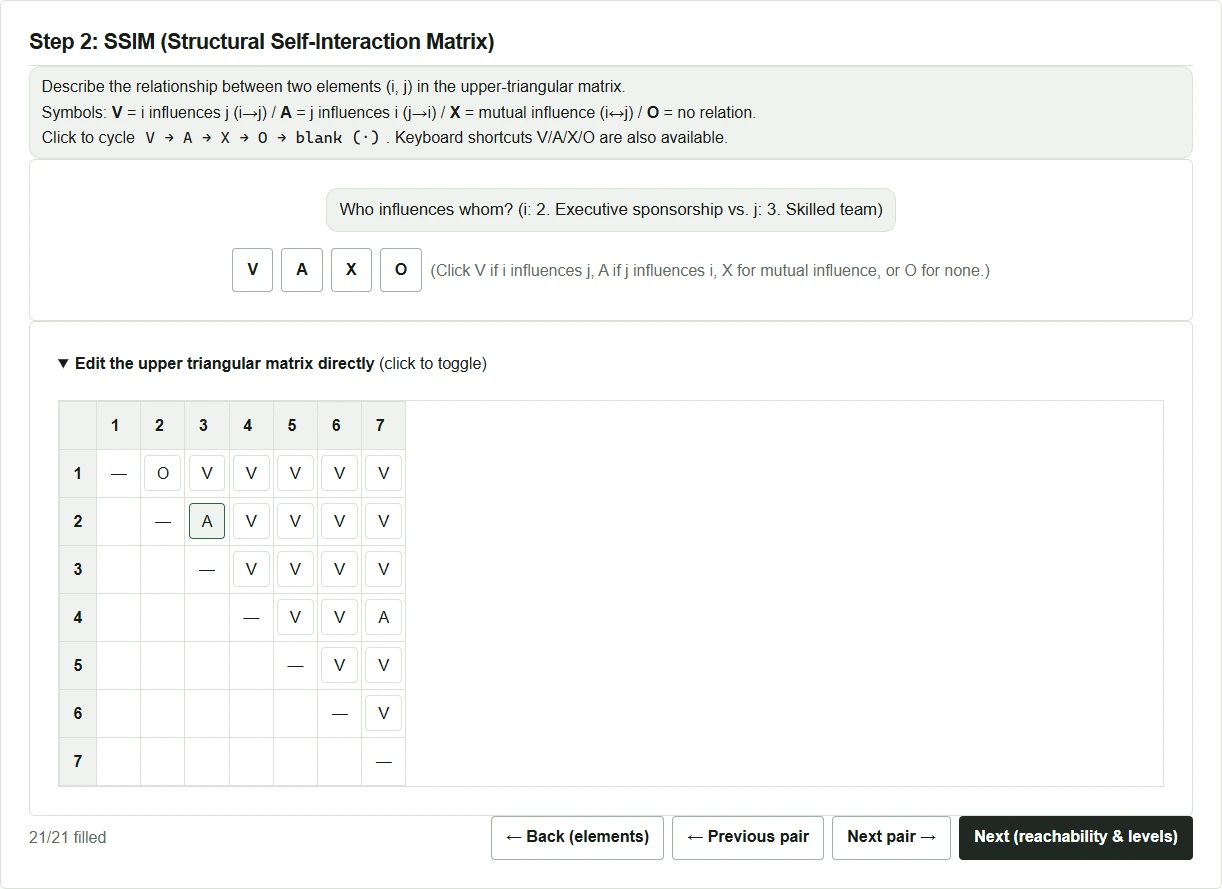
Click a cell or Tab to it and press Enter or Space to cycle through V → A → X → O → blank (·) → V. Focusing a cell shows the element names in the prompt above the table. For the rest of this example, leave the A as it is and click Next (reachability & levels).
Step 3 — Compare the closure and levels
Compare row 1, column 2 in the two matrices. It’s 0 in the IRM and 1 in the closure. The V from 1 to 3 and the A from 3 to 2 give the path 1 → 3 → 2. The 1 in the closure comes from the path through element 3.
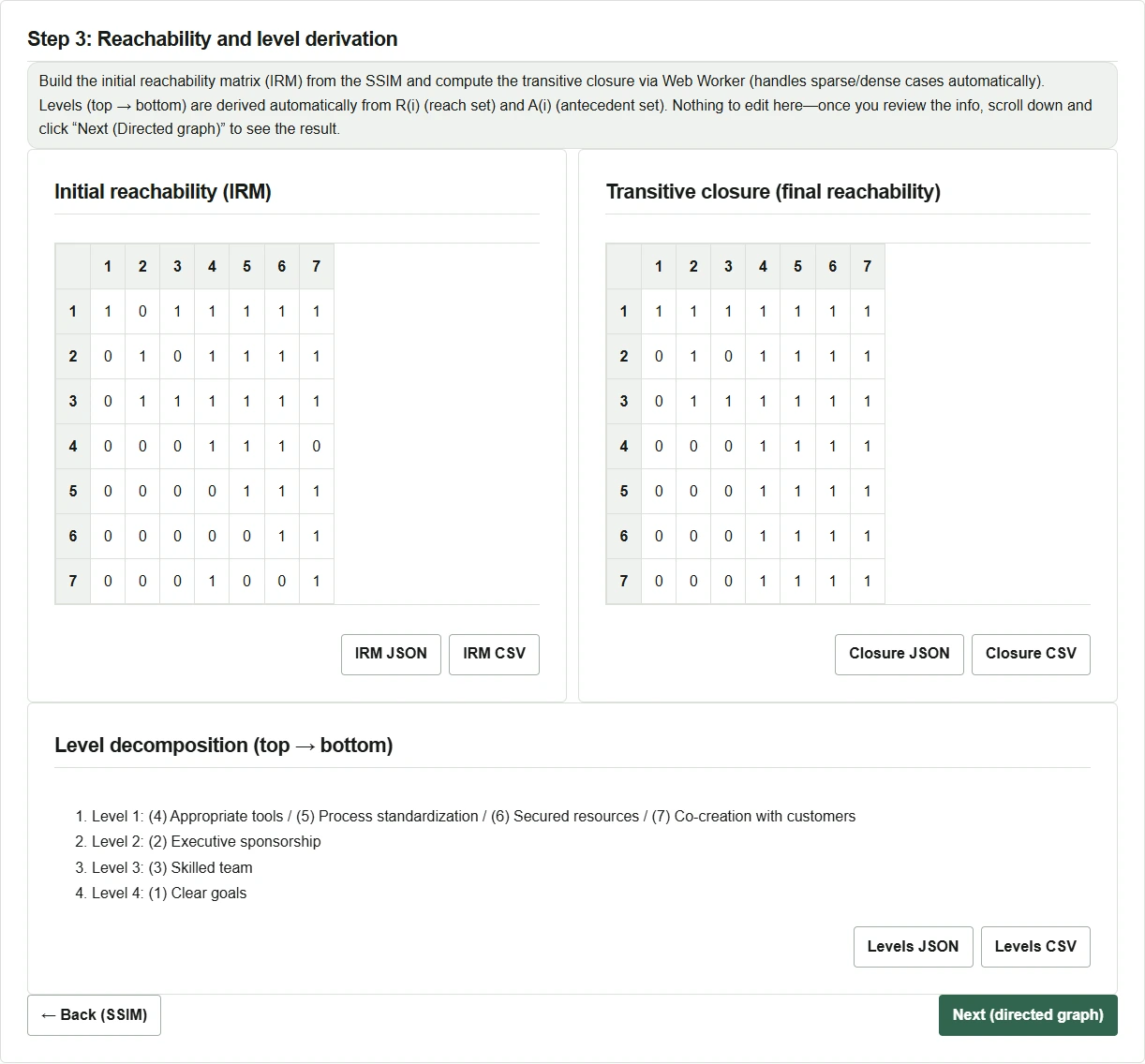
Elements 4 through 7 include the cycle 4 → 5 → 6 → 7 → 4. You can start anywhere in that group, reach the other three, and come back. There is no arrow leading back out to elements 1–3. For element 4, the reachability set is {4, 5, 6, 7} and the antecedent set is {1, 2, 3, 4, 5, 6, 7}. Their intersection matches the reachability set, so 4 goes in Level 1 along with 5–7. Once you remove them, the remaining levels are 2, then 3, then 1. You can export the matrices and level list as JSON or CSV.
Step 4 — Check and save the graph
Click Next (directed graph). Find the arrows from 1 to 3 and from 3 to 2 at the bottom. Then trace the cycle among elements 4–7 in Level 1. The corresponding block of the closure is full of ones. The graph lets you follow the arrows that make those elements mutually reachable. If the arrows on the same row overlap, check A in row 4, column 7 of the SSIM to confirm the return path from 7 to 4.
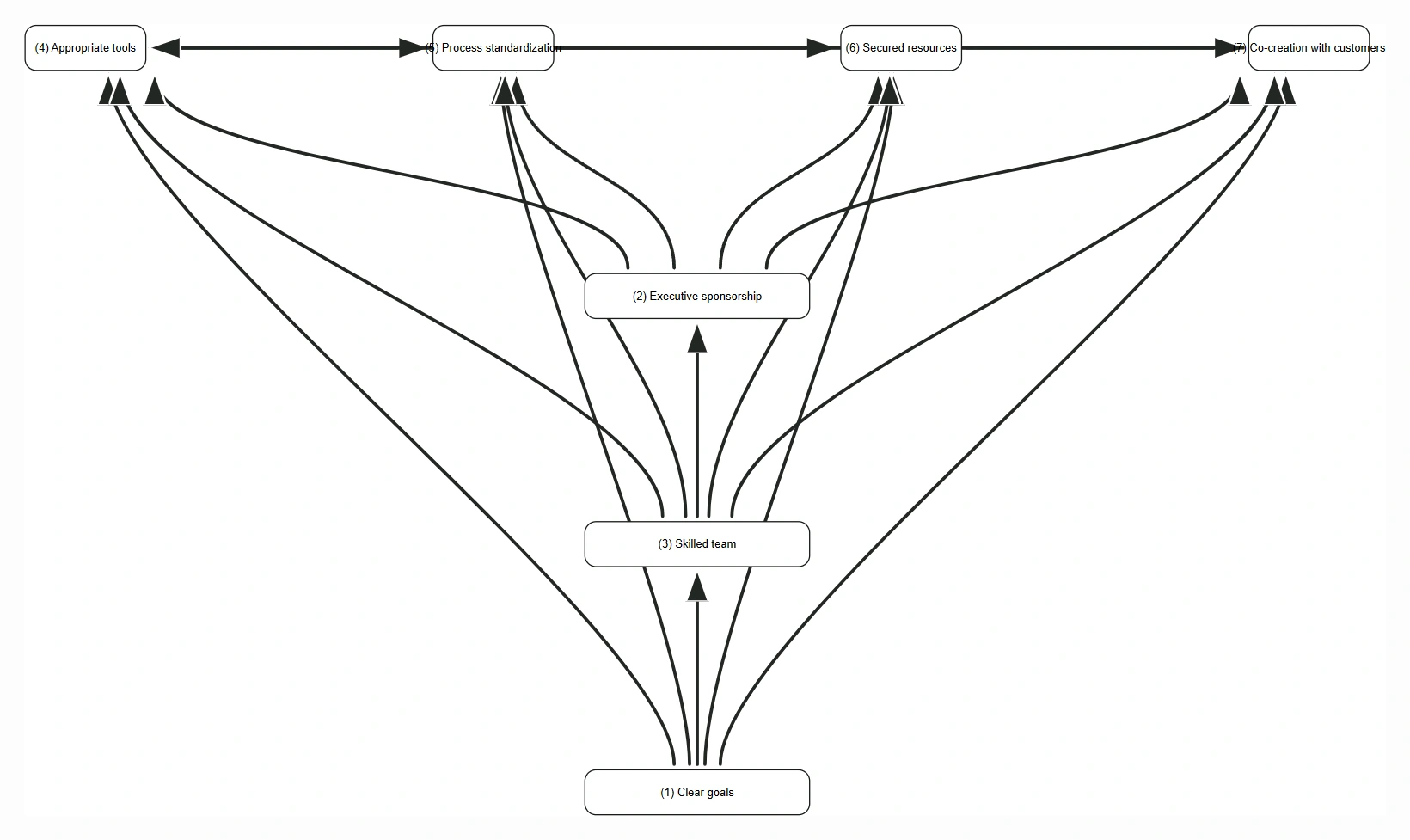
Use Download SVG to save the diagram. To revise the judgments later, also use Export model in the toolbar. Import model restores the elements and SSIM from that JSON file.
If I were bringing this diagram to a meeting, I’d keep a note about the reason for each arrow. “A skilled team earns executive support” and “we need executive support to develop a skilled team” use the same two elements and point in different directions. With the judgments written down, we can talk about exactly what would change the picture.
References
- John N. Warfield, “Developing Interconnection Matrices in Structural Modeling,” IEEE Transactions on Systems, Man, and Cybernetics, SMC-4(1), pp. 81–87, 1974. DOI
- John N. Warfield, “Toward Interpretation of Complex Structural Models,” IEEE Transactions on Systems, Man, and Cybernetics, SMC-4(5), pp. 405–417, 1974. DOI
- Y. Sawaragi and K. Kawamura (eds.), Sanka-gata Systems Approach: Methods and Applications, Nikkan Kogyo Shimbun, 1981 (in Japanese). CiNii Books